Sorry, no results.
Please try another keyword
Épisode
9 décembre 2025 -
Order of interviewees: Martin Grandjean (UNIL), Gabriel Galvez Behar (Université de Lille), Thomas Davies (University of London), Emeline Brylinski (UNIGE) et Daniel Laqua (Northumbria University)The centenary of the League of Nations and its International Committee on Intellectual Cooperation (1922) offered a moment to reflect on a century of global intellectual...
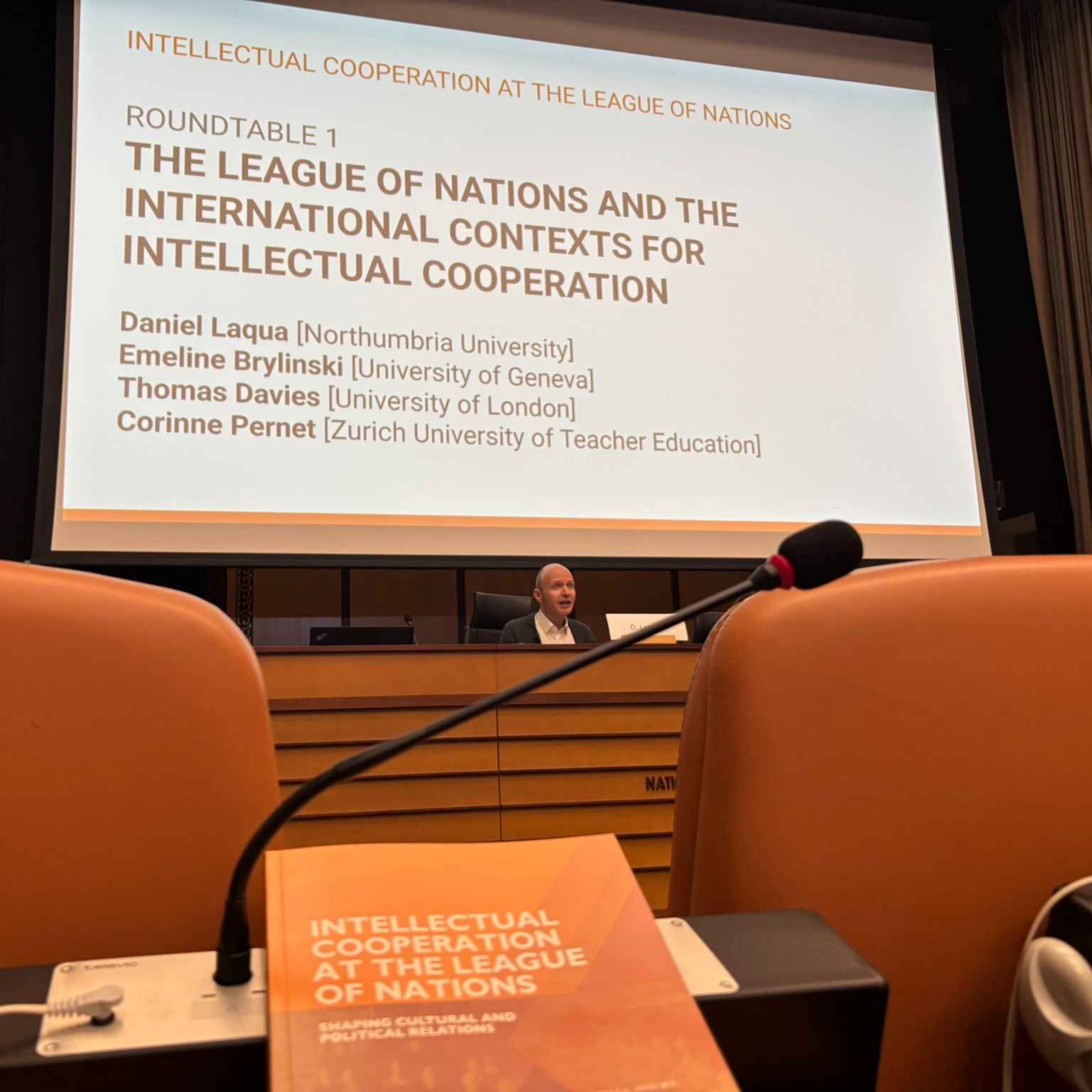
Order of interviewees: Martin Grandjean (UNIL), Gabriel Galvez Behar (Université de Lille), Thomas Davies (University of London), Emeline Brylinski (UNIGE) et Daniel Laqua (Northumbria University)The centenary of the League of Nations and its International Committee on Intellectual Cooperation (1922) offered a moment to reflect on a century of global intellectual exchange. In 2022, a conference at the Palais des Nations in Geneva gathered researchers who have long examined the League’s contributions to science, culture, education, and the arts. The event inspired a collective volume by 17 scholars, Intellectual Cooperation at the League of Nations: Shaping Cultural and Political Relations, edited by Martin Grandjean and Daniel Laqua, launched in early December during two round tables organized by the UN Library & Archives Geneva.The Geneva–Paris axis was central to the League’s intellectual cooperation, hosting debates, institutions, and networks that reached worldwide. Around forty national commissions implemented these initiatives, initially focusing on rebuilding universities and scientific networks in Eastern Europe after World War I. Cooperation later expanded to Asia and South America, reflecting the League’s broader international scope.Early efforts were dominated by scientific collaboration, inspired by the rise of international congresses in the late 19th century. From the late 1920s, cultural, literary, and artistic communities increasingly shaped the agenda. Post-war institutions like CERN continued this spirit of transnational scientific dialogue.Today, UNESCO carries forward this work on a global scale, integrating education, science, and culture. Education—largely neglected by the League—has become one of its core missions. Other organizations, such as WIPO, emerged from the same roots to address issues like intellectual property at the intersection of industry and innovation. These institutions embody the evolution of intellectual cooperation toward greater inclusivity.Thomas Davies (University of London) recalls early thinkers such as Paul Otlet and Marc-Antoine Jullien, who imagined systems of international intellectual exchange long before the League existed. Figures like Gilbert Murray and Alfred Zimmern played major roles during the League era, though many projects were interrupted by World War II. UNESCO later rebuilt these ambitions on a broader global basis.According to historian Gabriel Galvez Behar (University of Lille), early scientific cooperation often fell short: budgets remained incomplete, treaties stalled, and disagreements slowed progress. Yet these efforts laid the groundwork for post-war collaboration, influencing instruments like the Frascati Manual.Women participated from the beginning, though often in marginalized roles. While Marie Curie is a prominent exception, many women contributed through translation, coordination, and mediation. The book highlights their essential but long-overlooked work.Emeline Brylinski (University of Geneva) emphasizes the importance of the International Bureau of Education (IBE), founded in Geneva in 1925. As one of the first intergovernmental education bodies, it later helped shape UNESCO. Focused on primary education, the IBE complemented the League’s work on secondary and elite education. Guided by Jean Piaget—alongside Elizabeth Rotten, Pierre Bovet, Edouard Claparède, and Adolphe Ferrière—the IBE promoted educational innovation and global exchange. It continues to influence contemporary initiatives such as Education for All and Agenda 2030.The book revisits a century of intellectual cooperation, offering insights for today. In a period marked by weakening multilateralism, historical experience underscores the value of dialogue, trust, and long-term collaboration. Understanding past achievements and limitations can help institutions strengthen cooperation for the future.by David GlaserBook 991002769361802391_E.pdf Hébergé par Acast. Visitez acast.com/privacy pour plus d'informations.
Afficher plus
Order of interviewees: Martin Grandjean (UNIL), Gabriel Galvez Behar (Université de Lille), Thomas Davies (University of London), Emeline Brylinski (UNIGE) et Daniel Laqua (Northumbria University)
The centenary of the League of Nations and its International Committee on Intellectual Cooperation (1922) offered a moment to reflect on a century of global intellectual exchange. In 2022, a conference at the Palais des Nations in Geneva gathered researchers who have long examined the League’s contributions to science, culture, education, and the arts. The event inspired a collective volume by 17 scholars, Intellectual Cooperation at the League of Nations: Shaping Cultural and Political Relations, edited by Martin Grandjean and Daniel Laqua, launched in early December during two round tables organized by the UN Library & Archives Geneva.
The Geneva–Paris axis was central to the League’s intellectual cooperation, hosting debates, institutions, and networks that reached worldwide. Around forty national commissions implemented these initiatives, initially focusing on rebuilding universities and scientific networks in Eastern Europe after World War I. Cooperation later expanded to Asia and South America, reflecting the League’s broader international scope.
Early efforts were dominated by scientific collaboration, inspired by the rise of international congresses in the late 19th century. From the late 1920s, cultural, literary, and artistic communities increasingly shaped the agenda. Post-war institutions like CERN continued this spirit of transnational scientific dialogue.
Today, UNESCO carries forward this work on a global scale, integrating education, science, and culture. Education—largely neglected by the League—has become one of its core missions. Other organizations, such as WIPO, emerged from the same roots to address issues like intellectual property at the intersection of industry and innovation. These institutions embody the evolution of intellectual cooperation toward greater inclusivity.
Thomas Davies (University of London) recalls early thinkers such as Paul Otlet and Marc-Antoine Jullien, who imagined systems of international intellectual exchange long before the League existed. Figures like Gilbert Murray and Alfred Zimmern played major roles during the League era, though many projects were interrupted by World War II. UNESCO later rebuilt these ambitions on a broader global basis.
According to historian Gabriel Galvez Behar (University of Lille), early scientific cooperation often fell short: budgets remained incomplete, treaties stalled, and disagreements slowed progress. Yet these efforts laid the groundwork for post-war collaboration, influencing instruments like the Frascati Manual.
Women participated from the beginning, though often in marginalized roles. While Marie Curie is a prominent exception, many women contributed through translation, coordination, and mediation. The book highlights their essential but long-overlooked work.
Emeline Brylinski (University of Geneva) emphasizes the importance of the International Bureau of Education (IBE), founded in Geneva in 1925. As one of the first intergovernmental education bodies, it later helped shape UNESCO. Focused on primary education, the IBE complemented the League’s work on secondary and elite education. Guided by Jean Piaget—alongside Elizabeth Rotten, Pierre Bovet, Edouard Claparède, and Adolphe Ferrière—the IBE promoted educational innovation and global exchange. It continues to influence contemporary initiatives such as Education for All and Agenda 2030.
The book revisits a century of intellectual cooperation, offering insights for today. In a period marked by weakening multilateralism, historical experience underscores the value of dialogue, trust, and long-term collaboration. Understanding past achievements and limitations can help institutions strengthen cooperation for the future.
by David Glaser
Book 991002769361802391_E.pdf
Hébergé par Acast. Visitez acast.com/privacy pour plus d'informations.
Pas de transcription pour le moment.
David Glaser
David Glaser
Vous devez être connecté pour soumettre un avis.
David Glaser
Hotelier Isabelle von Burg : The Art of Welcoming the World
16 décembre 2025 · 41:47
From Santiago to Geneva : How Sport Breaks Barriers and Builds Inclusion
09 décembre 2025 · 28:01
Saint-Marin, la plus ancienne république du monde
09 décembre 2025 · 29:51
Haïlé Sélassié à Genève : Un appel historique au droit international en 1936
02 décembre 2025 · 22:02
Entretien avec Patrick Clastres : De Coubertin à Coventry, les JO entre idéalisme, pouvoir et diplomatie
24 novembre 2025 · 1:00:19
Le Bureau Des Histoires
Ma femme me préférait quand je buvais
13 novembre 2026 · 23:40
Parle-moi
Marion Ranvier, Directrice Générale de la Contentsquare Foundation
16 juin 2026 · 30:24
First Player – Boardgame
Avant de Ranger… Forestry
15 février 2026 · 17:04
Lanterne Magique
Questions de cinéma : Nicolas Saada et les voix du septième art
21 juin 2026 · 1:24:10
Ekos Afrique
Les derniers jours de Patrice Lumumba — Le chimiste et le crocodile (2/6)
15 février 2026 · 16:35
Tant qu’il y aura du Wi-Fi !
Paris Games Week 2026 : nouveautés, jeux, invités… Le directeur nous dit tout !
18 octobre 2026 · 1:00:10
Outpostcast – For All Mankind en français
Du drame familial aux catastrophes spatiales ! Rupture & Bent Bird (commentaire S1 épisodes 8 et 9)
04 avril 2026 · 1:14:36
Filles Faciles
Skins – la série des ados perdus et des parents inaptes
03 septembre 2026 · 1:18:40
La Richesse des Différences… pour te comprendre et te sentir accepté !
Les subtilité entourant l’Authenticité pour sortir de la lourdeur de l’hypocrisie ! – E31
11 septembre 2026 · 1:05:20
À table avec l’Histoire
Maïs : Anatomie d’une dépossession
24 avril 2026 · 20:39